All Payers
There are various types of authorizations used by the system to try and make sure providers get paid correctly for the work that they do. All service plans are also authorizations. If a client does not have a valid, current authorization in place then the system severely limits what services can be provided to the client. The goal is to have a string of continuous authorizations for a client with no gaps. For most payers there are no restrictions on backdating plans so this goal is pretty easily achieved. However, for OKHCA payers you can't arbitrarily backdate most plans so it can get complicated.
A Preauth Request is the initial authorization to provide services for the client. Normally it is a short term (3 month) authorization intended to pay for an initial assessment, initial service plan, and a few other services until the initial service plan is completed. However, certain payer sources will allow a 12 month duration for a Preauth Request in order to facilitate avoiding the use of a service plan all together. Some payers restrict the number of Preauth Requests per calendar year per client.
A Moderate Complexity Service Plan is an initial service plan, lasts for 6 months, and is normally completed before a Preauth Request expires. Some payers restrict a client to two service plans per calendar year. Effective dates for some payer sources can only be backdated 7 days.
A Low Complexity Service Plan is an extension service plan, lasts for 6 months, and normally directly follows either an initial or extension service plan. These are meant to be completed up to 14 days before or 7 days after the current initial or extension plan expires. Since expires dates in ChartCaddy are not inclusive, when possible the effective date of an extension plan should be the same as the expires date of the previous plan. When possible the Start and Stop date of an extension should be before the effective date or else the plan is "paying for itself", which some payer sources frown upon. Some payers restrict a client to two service plans per calendar year. Effective dates for some payer sources can only be backdated 7 days.
A Review Request functions like a Preauth Request except it is used only when an extension plan is not completed in time. Although Review Requests are available for all payer sources, they are only really useful for OKHCA payer sources that enforce the 7 day backdating. After that time period you must do a review request in order to do a new extension service plan, but the Review Request can only be be backdated up to 7 days as well. There is very little money granted with this authorization so you should limit what services you perform with this authorization other than the extension service plan.
Plans and services with names ending in "Preauth" are paid for by the Preauth Request or Review Request authorizations. Normally the initial service plan is a Preauth service but the extension service plan is not.
Plans and services with names ending in "Auth" bypass usage checks, run a much higher risk of the claim for the plan itself being denied, and therefore should only be used as a last resort. These services only exist for certain rare circumstances and should be disabled for most organizations.
Plans and services with names ending in "Supervised" only appear for certain payer sources that pay a different rate for service performed by providers that are under supervision for their license.
Plans and services ending in Bachelor's, Master's, or JOLTS pay a different rates based on the provider's credentials and only appear for certain payer sources.
OKHCA Payers
Below are the recommended authorization choices for agencies based on current OKHCA and DMH guidelines depending on the client's situation. Please keep in mind that Preauth Requests can be backdated up to a year, but all Review Request and Service Plan effective dates must be within 7 days of the current date in order to submit successfully.
If the client has never had a Preauth Request submitted, choose a Preauth Request and get it to Final status. Submit a Moderate Complexity Preauth plan before this request expires.
If the client had a Preauth Request submitted and it is not expired, then a Moderate Complexity Preauth plan should be submitted.
If the client had a Preauth Request submitted less than six months ago, you must extend the existing Preauth Request. Instructions for this can be found here. Then submit a Moderate Complexity Preauth plan before this Request expires. Instead of extending the Preauth Request a Moderate Complexity Auth plan, but then the claim for the plan itself has a high likelihood of being denied.
If the client had a Preauth Request submitted more than six months ago and the existing Preauth Request cannot be successfully extended far enough, you must submit a new Preauth Request and then a Moderate Complexity Preauth plan.
If the client has had a plan submitted to DMH and it expired less than 7 days in the past, there are two options. You can submit a backdated Low Complexity plan, or you can submit a backdated Review Request followed by a Low Complexity Preauth plan. Backdated items cannot overlap the old plan.
If the client has had a plan submitted to DMH and it is expired more than 7 days in the past, a Review Request can be submitted followed by a Low Complexity Preauth plan. Alternatively, a Low Complexity Auth plan can be submitted instead of the Review Request, but the likelihood that the claim for the Low Complexity Auth plan itself will be denied is high.
If a client had a Review Request submitted and a Low Complexity Preauth plan was not submitted before the Review Request expired 7 or more days in the past, the only option is to submit a Low Complexity Auth plan. There is a high likelihood of the claim for the plan itself being denied.
If the client had a discharge submitted, it was received by DMH, and the last Preauth Request was less than 6 months in the past, then a Moderate Complexity Auth plan is the only solution. The likelihood the claim for the plan itself will be denied is high.
If the client had a discharge submitted, it was received by DMH, and the last Preauth Request was greater than 6 months in the past, submit a new Preauth Request, then follow up with a Moderate Complexity Preauth plan. A Moderate Complexity Auth plan can be used instead of a new Preauth Request, but the likelihood of denial for the plan claim is high.
Just in case all that isn't confusing enough, we have prepared a helpful flowchart to go along with it.
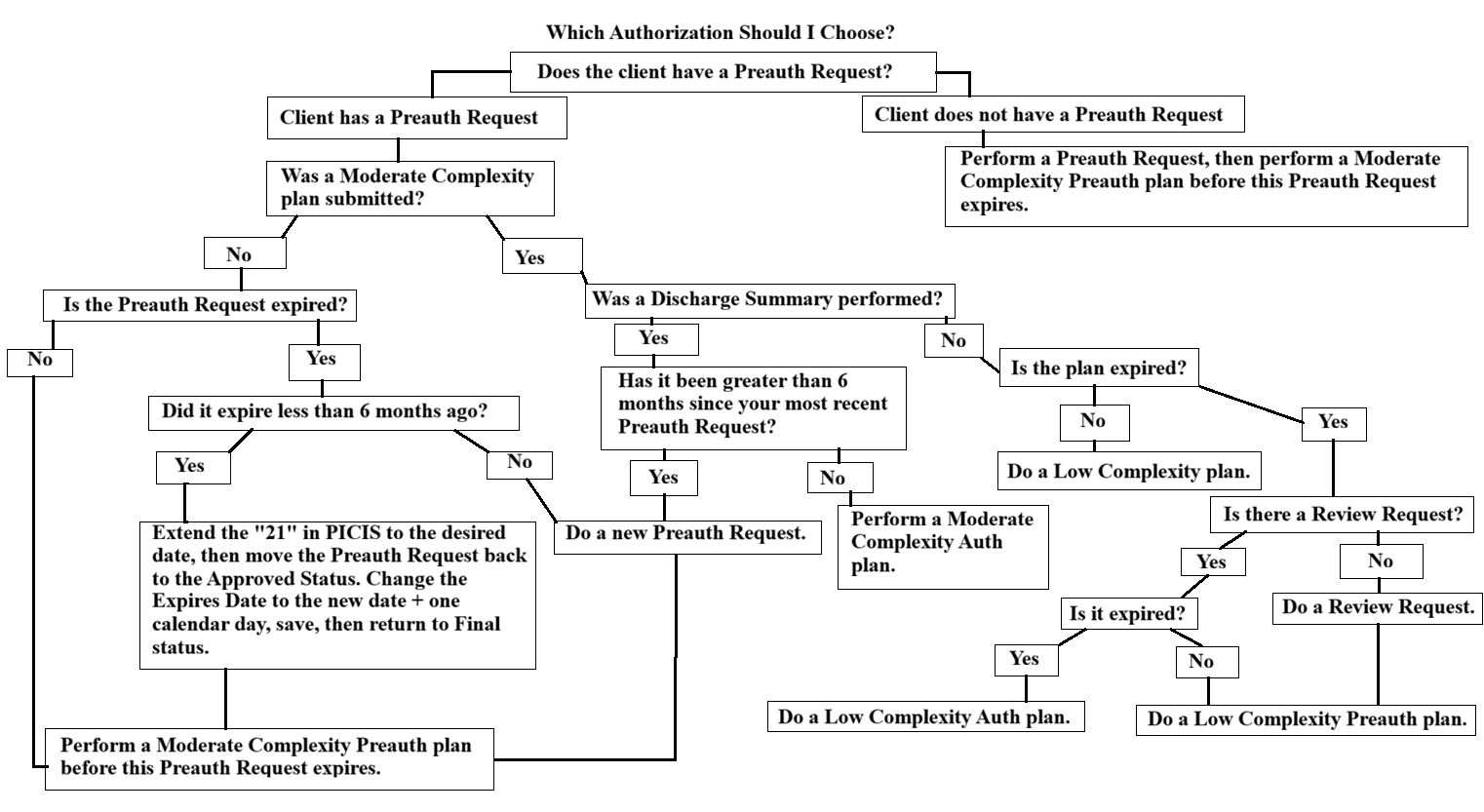 OKHCA Auth Flowchart
NOTE: If you ever have trouble finding a specific plan please don't hesitate to call or email us.